


By Dr. Francesca Bocca | July 29, 2026
رَبِّ اشْرَحْ لِي صَدْرِي وَيَسِّرْ لِي أَمْرِي وَاحْلُلْ عُقْدَةً مِنْ لِسَانِي يَفْقَهُوا قَوْلِي
This is the dua of Musa (peace be upon him) said before he stood in front of Pharaoh. It is a dua that every Muslim who tries to speak truthfully to other Muslims should use, because what I want to share with you today is, in some ways, very simple—and in other ways, hard to hear. It asks us to look at ourselves with a kind of precision that we have largely stopped using.
Let me also be clear about what this is not: This is not therapy. If something I say stirs something that needs care, please reach out to a professional. It is also not a sermon; I am not telling you what is permitted and what is forbidden. And it is not a complete training. What this is, is vocabulary. Just four words, and then three states. By the end of this read, you will have a basic map of yourself drawn in the language our tradition has used to describe us for over a thousand years.
This is the most useful knowledge I have to transmit to you. Knowing it changed my life. Please read it the way you would listen to someone explaining the grammar of a language you have been speaking your whole life. You already know what this is about, but you have never been told why it works the way it does. This is the grammar of our inner life. Bismillah, let us begin.
Part 1: The Map — What We Are Made Of
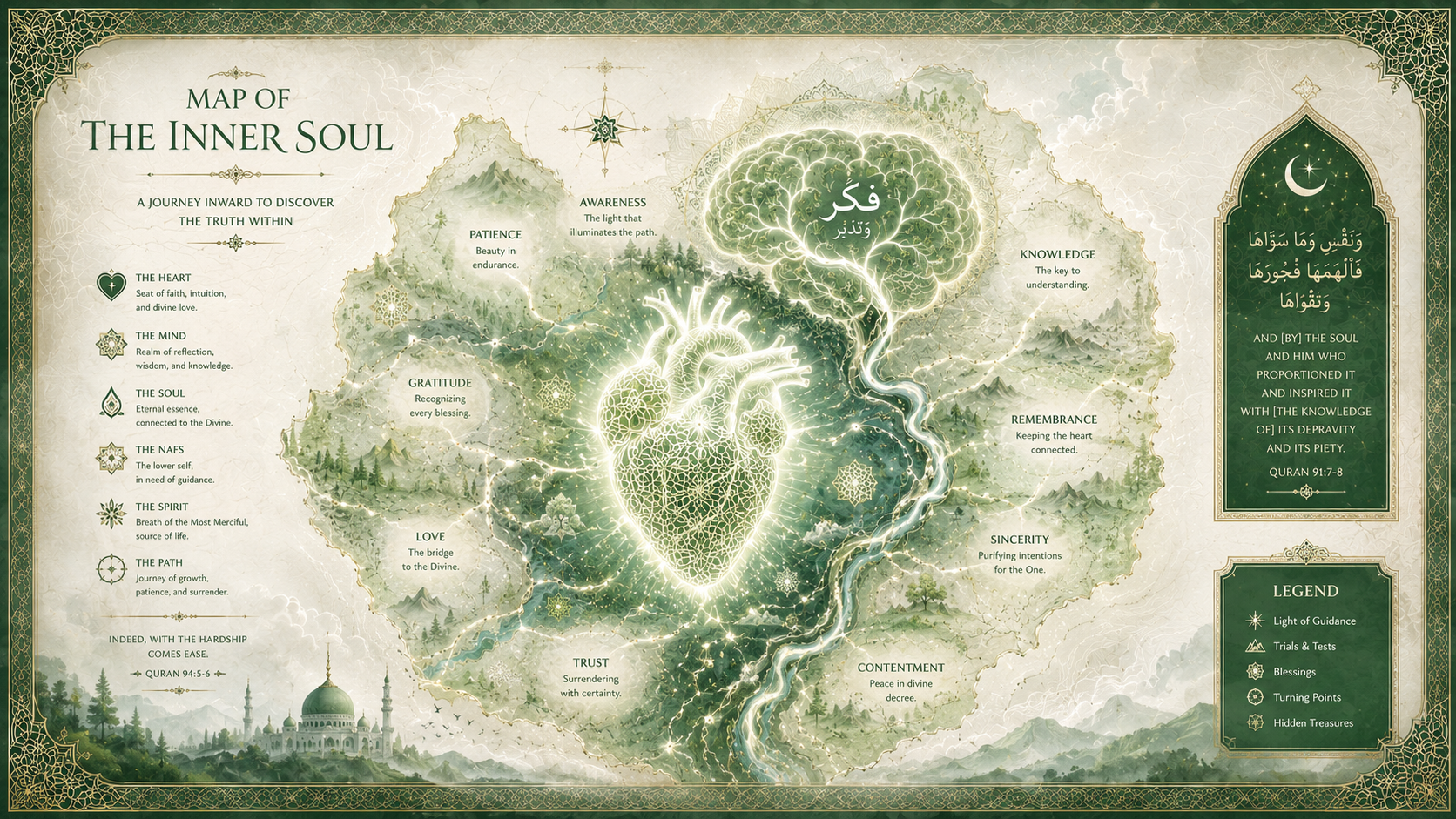
In this first part, I want to give you four words: Nafs, Qalb, Ar-Ruh, Fitra. According to the Islamic tradition, these are the four components of the human being. These are real, distinguishable parts of you, each needing its own kind of attention. We will take them one at a time, defining them and learning how to recognize them inside yourself.
1. Nafs: The Self That Wants
The Arabic root is nafasa. From it comes the word nafas (breath) and nafs (self). Etymologically, the nafs is what is most intimately yours; what breathes inside you. When you say, "I want, I don't want, I deserve, I'm hungry, I'm tired, I'm offended," it is the nafs speaking.
The simplest way to recognize the nafs in your daily life is this: The nafs is the part of you that uses first-person sentences. The part that says, "I would like to eat this," or "I would like to sleep more," or "I would like to be praised." Right now, as you are reading this, your nafs is speaking. It might be saying, "This is interesting," or "This is going on too long," or "I would like a cup of tea." That is the nafs. It is constant. It does not stop.
The work is not to make it stop. The work is to hear it, recognize it, and respond to it from a deeper part of you. Two clarifications:
- Narrow Definition: While the Quran sometimes uses nafs to mean the whole human being, we are using it in the narrower sense: the component that wants.
- Not Evil: The nafs is not the Western idea of a "lower self," and it is absolutely not Freud's "id" (a pure, animalistic drive needing repression). In our tradition, the nafs is not an animal. It is a part of the human being that needs to be trained, like a muscle to be developed or a horse to be ridden. If untrained, it commands you toward harm. If trained, it becomes one of your most precious resources.
2. Qalb: The Heart That Perceives
The second word is qalb, usually translated as "heart." That translation has caused massive confusion because English speakers associate "heart" with feelings, love, sentimentality, and Valentine's Day. The qalb is not feelings.
The Prophet (ﷺ) often made this supplication: "Ya muqallibal qulub, thabbit qalbi ala dinik" (O Turner of the hearts, make my heart firm upon Your religion). Why "Turner of the hearts"? Because the qalb is the organ of perception. It is the place where the human being sees clearly when healthy. Allah says in the Quran, "They have hearts with which they do not understand." This verse assumes the natural function of the qalb is to understand and perceive. If it fails, it is diseased.
The qalb is where you know if something is right or wrong, sincere or deceptive, selfish or selfless. When functioning well, you can sense the presence of Allah. When diseased, these perceptions become cloudy or blocked. This is why classical scholars cataloged the diseases of the heart (amrad al-quloob) with clinical precision: Kibr (arrogance), Hasad (envy), Riya (showing off), Hiqd (rancor), Ujb (self-admiration), Ghaflah (heedlessness), and Bukhl (miserliness).
Linguistically, qalb comes from a root meaning "to turn over" or "flip." It changes orientation constantly—turning toward Allah one moment, toward the dunya the next, toward a spouse with love, and then resentment, all within an hour. Therefore, healing the qalb is not achieved by sheer grit. It responds to attention, traditional nourishment, and ultimately to Allah, who turns it.
3. Ar-Ruh: The Dimension From Allah
For the third word, ruh, I want to take the deliberately restrained tone of our tradition. Allah says in the Quran: "And they ask you about the ruh. Say, 'The ruh is from the command of my Lord, and you have not been given of knowledge except a little.'" We are told what we need to know, and the door is closed. We will follow that tone.
The ruh is the dimension of you that comes directly from Allah, breathed into Adam (peace be upon him) and into every human being. It is not material, nor is it psychological. Ibn al-Qayyim points out a clinically vital fact: The ruh itself cannot be damaged. What gets damaged is its connection to the rest of you (your qalb, nafs, body).
When someone says, "I feel spiritually dead, I can't pray, I feel empty inside," their ruh is still intact and esteemed by Allah. The connection has just been blocked. Starving the ruh of its specific nourishment—the Quran, focused prayer, and dhikr (remembrance)—weakens this connection. The work of recovery is simply clearing the channels.
4. Fitra: The Original Orientation
The fitra is the original orientation every human is born with—the inborn inclination toward truth, toward Allah, and toward what is naturally healthy. The Prophet (ﷺ) said, "Every child is born upon the fitra..."
This is one of the most clinically important statements in the tradition. It means that underneath every human being—regardless of how they were raised, what they have done, or how far they have drifted—there is something oriented toward Allah. The fitra cannot be destroyed. It can be covered, distorted, suppressed, or drowned under trauma, habit, and sin, but it is still there, waiting.
This is why we never write anyone off. I have sat with patients who hadn't opened a Quran in 20 years and had committed unspeakable things, believing nothing was left of them. But the fitra was intact. The right key in the right lock—a beautiful recitation of Surah Ar-Rahman, unexpected mercy, the adhan—speaks the native language of the fitra, and they cry without knowing why.
For parents: The work of religious upbringing is not installing a foreign system into a child. It is protecting and watering what is already there.
Part 2: The Three States of the Nafs
Now that you have the four components, the obvious question is: What state is your nafs in? Because the nafs is trainable, the Quran names three distinct operational states.
1. Nafs Al-Ammarah: The Self That Commands
In Surah Yusuf, Prophet Yusuf says: "Indeed, the nafs commands towards evil, except those upon whom my Lord has had mercy." If a man of his impeccable conduct does not exempt his own nafs, we must be careful with ours.
From the inside, Nafs Al-Ammarah feels like an urge so dense and absorbing that there is no observer. There is just wanting. The hallmark phrase of this state is: "I couldn't help it," "I had no choice," or "It just happened."
- The Phone: You reach for your phone for one notification, and 45 minutes later you've scrolled three apps automatically.
- Anger: Your spouse says something, and a sharp reply is out of your mouth before you take a breath.
- A Small Lie: Someone asks why you are late, and a convenient excuse slips out in a millisecond.
If you recognize this, do not conclude you are a terrible Muslim. Every human has an Ammarah layer. The goal isn't elimination, but simple recognition. Just noticing, "Yes, that was Ammarah, there was no observer," is a movement out of it.
2. Nafs Al-Lawwamah: The Self That Reproaches
Allah swears by this state in Surah Al-Qiyamah: "And I swear by the self-reproaching soul." Allah does not swear by trivial things. In Lawwamah, there are now two voices. One wanted to do the thing; the other knew it was wrong. The signature phrase is: "Part of me wanted to, but part of me knew better."
This is where the majority of practicing Muslims live, and where the most work gets done. However, it has two malfunctions:
- Scrupulosity (Waswasa): The inner voice becomes constant, exhausting self-torture. You repent, but doubt its sincerity. You pray, but doubt your words and redo it. This is a disorder, not piety.
- Outward Deflection: Hyper-focusing on minor external rituals or constantly correcting other Muslims to escape your own inner work. Al-Ghazali calls this the Lawwamah costume worn over an Ammarah body.
The healthy work of this state is Muhasabah (daily self-accounting). Sit quietly for 5 minutes before sleep with a notebook and ask three questions:
- What did I do today that pleased Allah? (Do not skip this! The nafs resists gratitude).
- What did I do today that displeased Him?
- What did I do today where I am unsure?
When you do this, your nafs will make excuses ("I didn't mean it," "They started it"). Contrast this with the Prophets. Prophet Yunus in the whale didn't make excuses; he said, "There is no god but You... I was among the wrongdoers." When you take full responsibility, the door of Tawbah (repentance) opens. That is why Allah swears by this state.
3. Nafs Al-Mutma'innah: The Self That Has Come to Rest
At the end of Surah Al-Fajr, Allah says: "O reassured soul, return to your Lord, well-pleased and pleasing." This does not mean a life with no difficulty. The traffic is still bad, your boss is still rude. But the difficulty no longer destabilizes you.
The test for Mutma'innah is this: Praise does not inflate you, and criticism does not destroy you. Both pass through. Neither moves your core.
This is a destination, a place we visit and return from until we can stay longer. You cannot walk toward something you have no idea about. Knowing this state is possible gives the journey direction.
A Recognition Exercise (Your Homework)
I want you to think of the last 7 days and find three specific moments:
- Question 1: Find an Ammarah moment. An urge came and you followed it with no observer (e.g., snapping at your kids, overeating, doomscrolling).
- Question 2: Find a Lawwamah moment. You felt the pull of two voices. You knew it was wrong, but you could hear the conflict.
- Question 3: Find a brief Mutma'innah moment. A difficulty didn't destabilize you, or a compliment didn't inflate you, or a prayer felt like it was holding you.
Before you go to bed tonight, write those three moments down. If you do this for 5 minutes every night for 30 days, by our next class, you will be a different person inside because you will have started seeing.
Part 3: Suluk — The Work of a Lifetime
Once you have the map, the obvious question is: Where am I going, and how do I get there? The Islamic tradition calls this journey Suluk (traversing), and the traveler is a Salik. Part of this journey is Tazkiyatul Nafs (purification of the self).
Success in the Quran isn't defined by wealth or status, but by the state of your nafs: "Successful indeed is the one who has purified it, and ruined is the one who corrupted it."
We start in Ghaflah (heedlessness, autopilot). The first step is Yaktha (awakening)—triggered by a verse, a death, a hardship, or a quiet realization. Then begins the clinical, sequential work of treating the diseases of the heart, aiming toward Wilaya (closeness to Allah). This path is demanding, but it carries the sweetness of faith along the way.
Three Practical Corrections
Before you begin, avoid these common modern mistakes:
- The work is not fast. We expect results in six therapy sessions or a weekend intensive. Our tradition is not a marketplace. This is the work of a lifetime. Internalizing that you will never "finish" saves you from despair.
- The work is not solo. Every classical text presupposes Suhba (companionship). The romantic image of the lone seeker in the wilderness is Western, not Islamic. You need people who will tell you what you cannot see about yourself.
- The order matters. You cannot skip foundational discipline (Muhasabah) and jump to high spiritual stations. Skipping levels produces Ujb (self-admiration disguised as spirituality). You fall in love with yourself as a "spiritual person" rather than falling in love with Allah. There are no shortcuts.
The Map Applied: Upcoming Classes
Over the next four months, we will take this map to specific places where we all live:
- Class 2 (Next Month): Kibr and Impostor Syndrome. We will look at arrogance (Kibr) and how it hides in the modern Muslim as chronic self-doubt and impostor syndrome. Al-Ghazali understood these are two faces of the same disorder, and modern self-help ("you are enough") often makes it worse.
- Class 3: The Psychology of Muslim Marriages. What happens when two unhealed qulub enter a demanding covenant? We will look at what blocks the fitra in a marriage and what the tradition offers to recover it.
- Class 4: Pornography Addiction Through an Islamic Lens. The architecture of modern pornography is designed to bypass the observer and addict the Nafs Al-Ammarah. Willpower doesn't work here; we will explore the tradition’s powerful approach to compulsive desire.
- Class 5 (November): The Entitled Child and Exhausted Parent. How diseases of the nafs transmit in families. How untreated kibr or ghaflah shapes a child’s entitlement, and how to interrupt the cycle.
Reclaiming What Is Ours
The map of the human being already exists. It is in the Quran, the Hadith, and the writings of Al-Muhasibi, Al-Balkhi, Al-Ghazali, and Ibn al-Qayyim. It was refined for centuries. Then, we outsourced our souls to a foreign science that simply doesn't have the equipment to answer these questions.
The Muslim Ummah is sitting on the most sophisticated science of the soul ever developed in human history, and many of us do not know it is there. My goal is to put this map back into the hands of the people who own it. It is ours.
The work of the inner life is not optional; it is the assignment. In the next seven days, you will likely catch yourself in a craving or an argument, and a word from today—Ammarah, Lawwamah, Ghaflah—will pop into your mind. In that half-second, you will shift slightly beside the urge instead of being trapped inside it. That is the map starting to work.

Leave a Reply
Your email address will not be published. Required fields are marked *