

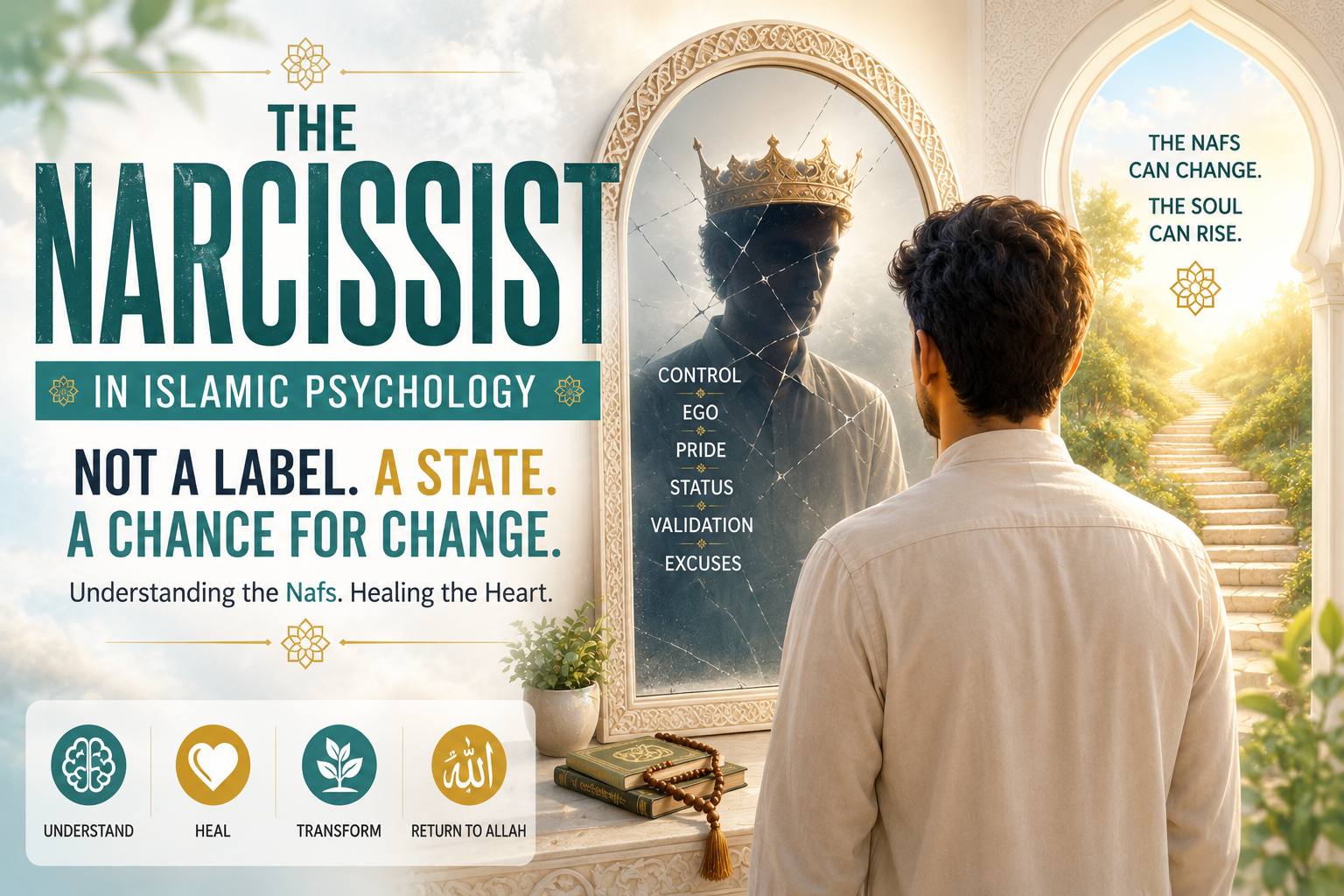

The label narcissist is everywhere on social media. Your boss is a narcissist. And the internet has turned that clinical term into a weapon. Something that you call people to explain why they hurt you. And somehow to justify demonizing them and cutting off any way for repentance or for change. But what is actually happening inside a person who behaves that way? What makes someone incapable of empathy? Obsessed with control. Unable to see beyond themselves.
A State of the Nafs, Not a Fixed Disorder
Modern psychology gives you a label. It's narcissistic personality disorder. And tells you it's largely untreatable. To manage your boundaries and move on. Islamic psychology looks at the same behavior and sees something very different. Not a permanent personality type. Not a fixed disorder. But a state of the nafs. A specific stage with a specific name and a specific path out.
So let's describe the pattern first because it's important that we're talking about the same thing. It's the person who centers every conversation on themselves, who cannot tolerate being wrong, who reacts to criticism with rage or with cold withdrawal. It's a person that manipulates or guilt trips and controls while genuinely believing that they're the victim. A narcissist also is the person that uses people as tools for their own validation or who shows love only when it serves their image, who is charming in public and cruel in private, who twists reality until you doubt your own perception.
Now, this pattern is real and the harm that it causes is real. So, if you have been on the receiving end of it from a parent, a spouse, a community leader, your pain deserves to be named. But, labeling the person and walking away is not the whole story because Islamic psychology asks a question that modern psychology doesn't. What is the condition of this person's soul and can it change?
Nafs Al-Ammarah: The Commanding Self
In Islamic psychology, the nafs, the self, has stages. These stages are not personality types that you're born with. They are states that the self can move through depending on awareness, effort, and divine grace. The lowest stage is called nafs al-ammarah, the commanding self. The Quran names this stage directly in Surah Yusuf,
"Indeed, the nafs is ever commanding towards evil."
This is the nafs that is ruled entirely by its own appetites, its own ego, its own desires. And it doesn't just desire like it commands. It takes over. It runs the show.
When you look at the behavior that we call narcissism through this lens, you see nafs al-ammarah operating at full power. Every feature lines up.
- The need for control: The ammarah cannot tolerate anything that threatens this dominance. Other people must serve its agenda. And when they don't, it punishes them.
- The inability to accept fault: Nafs al-ammarah cannot bear self-examination because honest self-examination would reveal its own diseases. So, it projects. Everyone else is the problem. This is what Al-Ghazali describes as ghurur, self-deception. And it is one of the ammarah's primary defense mechanisms.
- The exploitation of others: The nafs sees people as instruments, not as beings with their own nafs, their own pain, and their own rights before Allah. The nafs just sees this just as sources of validation, of service, or pleasure.
- The charm: And this is important that nafs al-ammarah is not stupid. It can be enormously intelligent, charismatic, and even religiously impressive. Al-Ghazali warns explicitly that the nafs can wear the clothes of piety while being driven entirely by the ego. A person can lead prayers, can give lectures, can quote Hadith, and be completely under grip of kibr, hub al-jah, the love of status, or ujb, self-admiration. The surface means nothing. The state of the heart means everything.
A Cluster of Heart Diseases
An important note. Most Western psychology describes the nafs at this stage, not allowing space for any of the other higher six stages. But let's remain in narcissism. If we look at Ghazali's map of the amrad al-qulub, the diseases of the heart, narcissistic behavior is not one disease. It's a cluster of diseases that are operating together.
Kibr (Arrogance)
There's kibr, arrogance, the deep belief that you are superior. Sometimes this belief is so deep that it's almost unconscious. The narcissist can't even see other people. They believe that their feelings matter more, that their perspective is the correct one. And the prophet sallallahu alaihi wasallam defines kibr as rejecting truth and looking down on people. That is the narcissistic pattern in one sentence.
Ujb (Self-Admiration)
Then we have ujb, self-admiration. This is an internal gaze that is permanently fixed on oneself. The person who is amazed by their own qualities, their own achievements, their own righteousness. Ujb blinds the person to their faults because they simply cannot stop admiring themselves long enough to look honestly and see us all as lacking and needy human beings.
Hubbul Jah (Love of Status)
Then we have hubbul jah, love of status. This is the craving for recognition, for influence, for importance. The narcissistic person doesn't just want to be good, they want to be seen as good. The audience is essential. Without it, the self collapses.
Ghurur (Self-Deception)
Then we have ghurur, self-deception. This is the [clears throat] mechanism that holds the whole structure together. In Islamic psychology, we see this in every sickness of the heart, some justification is going to be there. Ghurur is the nafs lying to itself, convincing itself that it's arrogance, it's confidence, uh calling cruelty strength, saying that manipulation is intelligence, or that control is love. Without ghurur, the person would see what they're doing, and they would be struck, disgusted by it even. But with ghurur, they are sealed inside their own distortion.
These diseases feed each other. Kibr generates the need for control. Ujb prevents self-examination. Hubbul jah makes the person depend on others' admiration. And then ghurur, it seals the whole system shut, so no light can get in. That's why it looks so intractable from the outside. Because it's not one problem, it's a locked system.
The Path Out: From Ammarah to Lawwamah
Modern psychology classifies narcissism as a personality disorder, meaning that it's considered a fixed, stable pattern that is extremely resistant to change. Many clinicians will tell you you cannot fix a narcissist. Like, protect yourself and move on. There's um practical truth in that advice. You cannot change someone else's nafs for them, but that's not only true for narcissists. And staying in a harmful situation waiting for a miracle is not what Islam asks of you.
But, the Islamic framework fundamentally disagrees with the idea that any state of the nafs is permanent. Because the nafs is not a fixed personality. It is a living and moving entity that can ascend or descend depending on what it's fed, what it practices, and whether it is touched by divine guidance. Nafs al-ammarah is therefore a stage, not a sentence. And the same nafs that commands towards evil can, through a process of awakening and a lot of struggle, become nafs al-lawwamah, the self-reproaching self. The self that begins to see its own disease. And that is the turning point.
The Awakening (Yaqazah)
Now, here's the difficult truth. That you cannot therapize someone out of nafs al-ammarah through any technique. You cannot teach empathy to a self that does not know it is sick. So, the ammarah's defining feature is that it does not see itself as the problem. So, this ghuroor, this self-deception, is the lock on the door. The only thing that breaks through ghuroor is what our tradition calls yaqazah, awakening.
This is a moment often triggered by crisis, loss, or or intervention, where this veil lifts and the person sees themself as they actually are. Not anymore as the hero of their own story, but as a nafs in desperate need of healing. That moment is terrifying. It's the collapse of every self-image that the ammarah has built. And it's also the most important moment of a person's spiritual life. Because from that collapse, tawbah, repentance, becomes possible.
Tawbah, which is genuine repentance, is the door from ammarah to lawwamah. The self that was commanding now begins to reproach itself. What have I done? Who have I hurt? What have I become? That self-questioning, that honest reckoning, is the nafs al-lawwamah awakening. And it is the beginning of change. Al-Ghazali describes this transition as the hardest journey in the human experience. Because the ammarah does not go quietly. It fights. It rationalizes. It bargains. It will use every trick, including religious language, to avoid any moment of genuine self-confrontation. But when that moment comes, and the person makes a sincere turn towards Allah, the transformation that follows is real. Not easy, and not quick, but real.
For the Victims and For Yourself
So if someone you know in your life has this pattern, inshallah, we will make longer videos on specific cases as this can get tricky especially in the family. Understanding that they are in the grip of nafs al-ammarah gives you compassion without requiring you to accept any abuse. You can see the disease without becoming its victim. You can even make dua for their awakening without sacrificing your own well-being. And protecting yourself in this way is not a failure of love, is preservation of the self, hifz al-nafs, and it is an Islamic obligation.
And as you listen to this, something inside you recognized not the person who hurt you but yourself. That recognition is the beginning. That discomfort, that shock of honest self-seeing, that is the lawwamah stirring. That is the crack in the ghurur. So please don't run from it. It's the most important thing that could happen to you. The path from ammarah through lawwamah towards the higher states of the nafs is the entire project of tazkiyah. It requires tawbah, muhasabah, honest community, and above all the mercy of Allah because no one makes this journey alone.
Conclusion: The Journey That Matters
So narcissism is not a personality type. It is a stage of the nafs at its lowest stage. Commanding, controlling, self-deceiving, it is a cluster of heart diseases that operate as a locked system. Modern psychology says it cannot be fixed. Islam says the nafs is designed to grow. But growth requires something that no technique can manufacture. The moment of awakening when the self of finally sees itself and from that seeing the turn towards Allah.
If you know someone trapped in this state, make a dua for their yakada. It may be the most powerful thing you can do for them. And if that someone is you, the door is open. It's always been open. The one who created your nafs also created the path from nafs al-ammarah to mutma'innah. The journey is hard, but it's the only journey that matters.
Source and Credit: https://youtu.be/b46qKes2u20?si=08fuxFSfbPwg8emO


Leave a Reply
Your email address will not be published. Required fields are marked *